
What is renewable energy?
Energy that comes from resources which are naturally replenished during a human timescale is classed as ‘renewable’. This can be from sources such as sunlight, wind, tidal, or geothermal heat, and are used in four areas:
- Electricity generation
- Hot water heating
- Motor fuels
- Rural (off grid) energy
Why is it important?
Most of our energy today still comes from fossil fuels such as coal, oil and natural gas. Not only are these sources non-renewable, meaning they will run out, they also contribute to global warming. When these fuels are burned, they release harmful gas emissions such as carbon dioxide. Though the Earth has a natural blanket of these gases to filter the sun’s rays in and out, adding to this increases the thickness, and stops some of the rays being reflected out – thus heating the planet. If the Earth continues to heat up it can lead to dramatic climate changes including floods and storms. That’s why it’s important that we try to harness renewable energy sources as much as possible, to protect our planet and so that we have a constant source of energy. In addition, renewable energy means that countries will no longer have to rely on foreign oil, they will become energy independent, and more jobs will be created within their own country. The main downside to renewable energy sources is the expense for the technology used.
What are the types of renewable energy?
Solar energy

Sourcing energy directly from the sunlight creates solar energy. With commercial and industrial uses, this energy can be used for heating and lighting in homes, as well as generating electricity. There are a variety of ways to harness the energy from sunlight, some of these include;
- Photo-voltaic systems – this is the process of converting light (photons) into electricity.
- Solar hot water – the process of heating water with solar energy. It can be used to heat water in buildings and swimming pools, this is usually done through a flat plate collector. A box with a transparent cover faces the sun, tubes run through the box carrying the water which are attached to a black absorbed plate. The plate absorbs the heat from the sun and in turn heats the fluid passing through, a storage tank will then hold the hot water for when it is needed.
- Solar electricity – using the sun’s heat to produce electricity. A new generation of power plants are using solar power systems instead of fossil fuels to use the sun as a heat source to boil water. The steam from this then rotates a large turbine which activates a generator to produce electricity.
- Passive solar heating and day lighting – the use of solar energy to provide heat and light to buildings. The sun naturally produces heat and light to the Earth, buildings are now being designed to take advantage of this. Passive solar heating involves using materials that absorb and store the sun’s heat during the day, to be slowly released at night when it is needed. By designing a building with properly facing windows and open space, the sun’s natural light can be used to its full advantage.
Wind energy
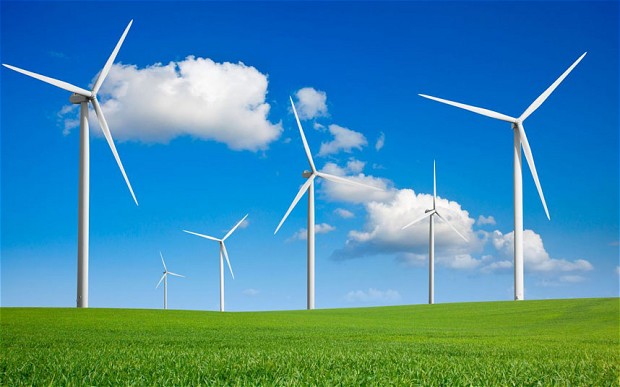
Wind turbines are used to capture the energy from driving winds, they are mounted 30 meters or more above the ground to take advantage of the faster and less turbulent winds. There are usually two or three blades which spin because when the wind blows a pocket of low-air pressure forms on the downwind side of the blade. This spinning, propeller-like motion causes a generator to spin, producing electricity.
Hydroelectric energy/hydro-power
Capturing the energy that is created by flowing water is called hydro power, for example on a dam or river.
Bio-energy

Biomass is the organic matter that makes up plants. It can be used to produce electricity, fuels and chemicals – this is known as bio-energy. The two most common types are ethanol and bio-diesel. Ethanol is used as a fuel additive to help reduce a vehicle’s emission, however the vehicle has to be flex-fuel compatible. Bio-diesel is made by combining alcohol with vegetable oil, animal fat or cooking grease, but unlike ethanol it can be used in its purest form as a fuel for diesel engines.
Hydrogen
This element is found in copious amounts on the Earth, but in compound form, it has to be separated to occur as a gas. Once this is done, it can be burned as a fuel or converted to electricity.
Geothermal energy
The Earth’s internal heat can be used to produce electricity, as well as being used to heat and cool of buildings. This clean and sustainable source can be found in both shallow ground, and miles into the Earth’s surface. A geothermal heat pump can be installed in a building to harness this heat and pump it into the indoor air system, it can also be used to heat the water within a building. Additionally, the steam created from geothermal energy can be used in power plants to generate electricity.
Ocean/Tidal energy
The ocean can provide two types of energy; thermal from the sun’s heat, and mechanical from its tides. The sun heats the surface of the ocean, and the temperature difference between this and the deeper parts of the ocean can be used to create thermal energy. Tides are usually converted to electrical energy through the use of dams.
What are the most exciting renewable energy projects today?
The future is looking bright for renewable energy. In a bid to tackle global warming, and become more energy independent, countries from all over the world are creating bigger and better renewable energy projects.
- Three Gorges Dam
In China, the Three Gorges Dam produces the same amount of electricity as 18 nuclear power plants or 18 gigawatts (2011). But it may have competition in the form of the Grand Inga Dam, which will be situated in the Democratic Republic of Congo. Due for completion between 2020 and 2025, this dam could produce up to 39 gigawatts of power.
- Aguçadoura Wave Farm
Off the coast of Portugal sits the world’s first and only commercial wave power plant. Currently producing around 2.25 megawatts, there are plans to expand the plant further to reach 21 megawatts.
- Olmedilla Photovoltaic Park
This plant in Spain uses over 150,000 flat solar panels and produces around 60 megawatts of electricity on a peak day.
- SeaGen Turbine
These turbines are powered by water rather than wind, using the tidal power and deep ocean currents. Situated in Ireland, this turbine will soon lose its title as largest in the world as South Korea get ready to launch their own, larger set of turbines.
- Texas wind farms
Texas in the USA currently holds 5 of the largest on shore wind farms in the world.
- Ivanpah Solar Facility
This facility in California is intended to be able to power 100,000 homes.
- Gansu Wind Farm
Even without yet being completed, this wind farm in China is the largest in the world. Its capacity is over 5000 megawatts but this is expected to grow to around 20,000 megawatts by the time it is completed in 2020.
- The Geysers
In California, this massive geothermal field is the biggest single one in the world and has a capacity of around 2000 megawatts.
Exciting projects in the UK
In some respects, the UK is at the forefront of harnessing renewable energy sources. In solar energy, the UK is a huge rival as it is now the third in the world for large scale solar capacity.
Off shore wind farming is also a big project in the UK. Just off the coast of Skegness, England a wind farm is producing up to 194 megawatts of electricity at peak. Recently, plans for an offshore wind farm twice the size of this has been given the green light to go ahead in Yorkshire. There’s also The London Array offshore wind farm which is currently ranked 6th largest in the world. In Swansea, plans for the world’s first tidal energy scheme are in place.
Just last year, eight renewable energy projects were approved for the UK. Originally, 57 projects were put forward and eight were chosen – but it has been expressed that the government would have backed more if they could. These projects are:
- Beatrice offshore wind, Outer Moray Firth – planned for construction in 2016 and with the potential to generate up to 750 megawatts of renewable energy, it will also create a huge amount of jobs.
- Burbo Bank offshore wind, Liverpool Bay – with 25 wind turbines this offshore wind farm is able to generate up to 900 megawatts of renewable energy.
- Drax 2nd biomass conversion unit, Selby – Drax aims to transform itself into a predominately biomass-fueled generator. The first unit was converted in 2013, the second was fully converted late in 2014 and the third is set to be converted in 2015/2016.
- Dudgeon offshore wind, north of Cromer – boasting enough ‘green’ energy to be able to power over 410,000 homes across the UK, this offshore wind farm has an installed capacity of around 400 megawatts.
- Hornsea offshore wind, off the East Yorkshire coast – this wind farm covers around 400 square kilometers and has a total capacity of 1.2 gigawatts.
- Lyne mouth biomass conversion, Ashington, Northumberland – the plant is aiming to convert to biomass in 2015 and has a capacity of 420 megawatts.
- Teesside biomass with combined heat and power, Middlesbrough – eventually the plant will be able to generate almost 300 megawatts of electricity running exclusively on biomass.
- Walney extension offshore wind, off Walney Island – the proposed wind farm extension will cover an area of 149km2 and will have a potential stored capacity of 660 megawatts.